
What does the term trace refer to in circuit card assembly manufacturers?
term trace refer to in circuit card assembly manufacturers
In the realm of circuit card assembly manufacturing, the term “trace” holds significant importance, acting as a foundational element in the creation of electronic devices. Understanding what this term refers to is essential for anyone involved in the design, production, or troubleshooting of circuit boards.
At its core, a trace on a circuit card assembly manufacturers is a conductive pathway that connects different components, such as resistors, capacitors, and integrated circuits. These pathways are typically made of copper and are etched onto the surface of the board during the manufacturing process. The purpose of traces is to facilitate the flow of electrical current between various parts of the circuit, enabling the device to function as intended.
Traces come in various shapes, sizes, and configurations, depending on the specific requirements of the circuit design. They can be thin or thick, straight or curved, and they may branch off to connect multiple components or form complex networks. The layout of traces on a circuit board is carefully planned during the design phase to optimize performance, minimize interference, and ensure reliable operation.
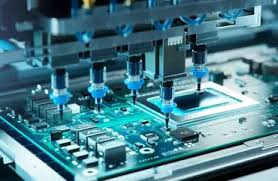
What does the term trace refer to in circuit card assembly manufacturers?
In addition to carrying electrical signals, traces also play a crucial role in controlling the flow of current within the circuit. By varying the width, length, and spacing of traces, designers can regulate impedance, voltage drop, and signal integrity, which are critical factors in high-speed digital and analog circuits.
Furthermore, traces must be designed with consideration for factors such as thermal management and electromagnetic compatibility (EMC). Heat generated by active components or high current loads can affect the performance and reliability of a circuit, so traces may be widened or routed away from sensitive areas to dissipate heat more effectively. Similarly, traces must be positioned and shielded to minimize electromagnetic interference (EMI) and ensure compliance with regulatory standards.
In the context of manufacturing, the term “trace” also refers to the process of inspecting and tracking individual components as they move through the production line. Modern manufacturing facilities employ advanced techniques such as automated optical inspection (AOI) and X-ray imaging to examine circuit boards for defects, ensuring that traces are intact and free from any defects or anomalies.
Traceability is another critical aspect of circuit board manufacturing, especially in industries where quality control and regulatory compliance are paramount. Manufacturers use various methods, such as barcoding and serialization, to trace each component’s origin, production history, and assembly process, enabling them to identify and address any issues that may arise during manufacturing or in the field.
In summary, the term “trace” in circuit card assembly manufacturing encompasses both the physical conductive pathways on a circuit board and the processes involved in ensuring their integrity and quality. Understanding the role of traces is essential for designing, producing, and troubleshooting electronic devices, as they form the backbone of modern electronics and underpin their functionality and reliability.